
AI Avatar Roleplays: A Practical Guide to Scaling Leadership Practice Across Your Organization
July 22, 2026
9 minutes
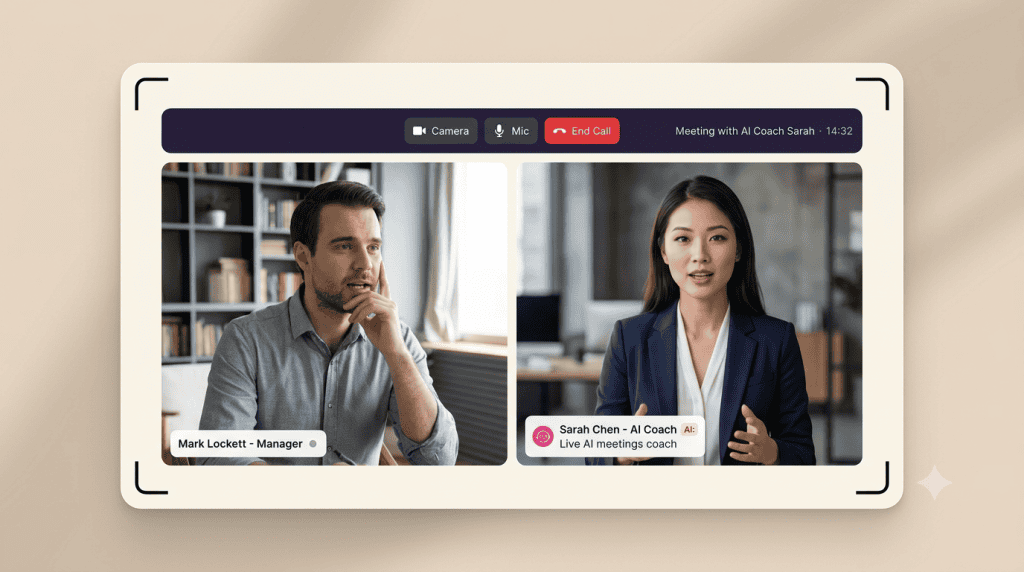

Gartner projects that 60% of large enterprises will have incorporated AI-based simulation tools into their employee development strategies by the end of 2026, and 68% of companies are already exploring or implementing AI-powered tools specifically for leadership development and coaching simulations (CareerTrainer.ai, 2026). AI roleplay delivers 80–90% completion rates and 70–80% knowledge retention after 30 days — more than double the 20–30% retention of conventional e-learning courses.
So what exactly is an AI avatar roleplay, and is it actually different from the “practice scenarios” L&D teams have been running in workshops for a decade? And more importantly: how does an HR team scale it across hundreds or thousands of managers without it becoming another unused module in the LMS?
This guide covers what AI avatar roleplays are, the research behind why they work, how they differ from traditional training, where organizations are actually using them, and what to look for before you invest in a platform.
- An AI avatar roleplay is a simulated conversation with a life-like character that adapts in real time — not a chatbot, not a scripted video.
- AI roleplay delivers 70–80% knowledge retention after 30 days, vs just 20–30% for conventional e-learning.
- It closes the Practice Gap — the space between understanding a concept and executing it under real pressure.
- The biggest use case is manager development — feedback, delegation, and conflict conversations rehearsed before they happen live.
- The most common failure isn't design — it's launching it like a generic e-learning module with no manager involvement.
What Is an AI Avatar Roleplay?
An AI avatar roleplay is a simulated conversation between a learner and a life-like character — voice or text-based — designed to behave like a real counterpart: a defensive direct report, an angry client, a peer resisting feedback, a resistant stakeholder in a negotiation. The learner practices the conversation in real time and receives feedback on tone, structure, and technique, either during the exchange or in a debrief immediately after.
This is a meaningfully different category from a chatbot or an FAQ assistant. The AI avatar isn’t answering questions — it’s playing a role, adapting its responses based on what the learner says, and creating the mild discomfort and unpredictability of a real conversation. That unpredictability is the point: a scripted video can’t push back when a learner’s delivery is weak, and a slide deck can’t simulate what it feels like when a direct report gets defensive mid-conversation.
Coachello’s AI Avatar Roleplays are built around this exact mechanic — practicing feedback, delegation, and conflict conversations against a realistic AI counterpart, available on demand rather than scheduled weeks in advance.
Which AI coaching solution fits your team?
Why AI Roleplay Actually Builds Skill: The Practice Gap Model
Most corporate training operates on a flawed assumption: that understanding a concept is the same as being able to execute it under pressure. It isn’t. A manager can understand the structure of a good feedback conversation and still freeze the moment a direct report pushes back. That gap between knowing and doing is what Coachello calls the Practice Gap Model — managers fail in real situations not because they lack knowledge, but because they were never given a safe place to practice before being asked to perform live.
AI roleplay closes that gap directly. It matches the four conditions of Anders Ericsson’s deliberate practice framework — a defined skill target, practice at the edge of current capability, immediate feedback, and repetition — better than almost any other training format available at scale. Learners using AI simulation roleplay improve targeted skills by 25.9% on average and reach full on-the-job productivity roughly 30% faster than learners trained through conventional methods (CareerTrainer.ai, 2026).
For the full research behind why this works — the neuroscience of emotionally engaged learning, the deliberate practice literature, and the completion-rate data — see why AI roleplay is scientifically effective.
How AI Avatar Roleplays Differ From Traditional Role-Play Training
Live, facilitator-run role-play has always worked — the research on retention and engagement has supported it for years. What’s changed is what AI adds on top of it, not what it replaces.
| Traditional Live Roleplay | AI Avatar Roleplay | |
|---|---|---|
| Availability | Scheduled sessions, limited to workshop hours | 24/7, on demand, right before a real conversation happens |
| Repetition | Usually one or two attempts per session | Unlimited attempts until the behavior sticks |
| Consistency of feedback | Varies by facilitator or peer | Standardized against the same competency framework every time |
| Psychological safety | Practicing in front of peers can inhibit some learners | Private practice removes the fear of judgment |
| Scalability | Limited by facilitator availability | Scales to thousands of employees simultaneously |
Neither format is obsolete — the strongest programs combine both, using AI for repetition and private practice, and live sessions for group dynamics and facilitator judgment. The underlying instructional design principles carry over directly from traditional role-play; what changes is who — or what — the learner is practicing against. For the full framework on structuring either format properly, see how to build a role-play training program.
See What a Real AI Avatar Roleplay Feels Like
Reading about deliberate practice is one thing. Experiencing a defensive direct report push back in real time is another.
Try a live AI Avatar Roleplay and get an instant behavioral debrief — the exact experience your managers would practice on before a real conversation.
Try our AI Avatar Roleplay Coach →
Where Organizations Are Actually Using AI Avatar Roleplays
The most common use case is manager development: rehearsing feedback conversations, delegation, performance discussions, and conflict resolution before having them for real. This is also where the data is strongest — 68% of companies already exploring AI-powered simulation tools are doing so specifically for leadership development, not customer-facing use cases (CareerTrainer.ai, 2026).
First-time and frontline managers are a particularly high-value application, since most are promoted without any formal leadership training and are learning to manage people in full view of the team they now lead — a dynamic explored in more depth in why manager engagement is collapsing. AI sales roleplay training for sales teams is a second major use case, rehearsing discovery calls and objection handling — covered in how roleplay helps measure and develop your sales team. Beyond those two, organizations are using it for cross-cultural communication, DEI-related conversations, and onboarding new hires into how the company actually handles difficult moments — see 10 ways to use role-play in professional development for the full range.
How to Launch a Program That Doesn’t Become Another Unused Tool
The most common failure mode isn’t poor instructional design — it’s a launch that treats AI roleplay like any other e-learning module: a link in an email, no manager involvement, no context for why it matters. Programs that get real adoption activate managers before employees, open with a short self-assessment so participants see their own skill gaps before practicing, and build the program around each person’s actual development needs rather than a fixed, generic curriculum.
Coachello structures this through tripartite sessions — coach, employee, and their own manager — at the start and end of a program, so practice stays connected to real performance conversations rather than existing in isolation. The complete step-by-step rollout framework is covered in how to launch a corporate role-play program.
How to Measure Whether It’s Actually Working
“Completion rate” and “satisfaction score” are not the same as behavior change, and treating them as equivalent is how L&D teams end up unable to defend a program’s budget. What should actually be tracked is competency progression over time — whether a manager’s feedback delivery, active listening, or delegation actually improves across repeated attempts, not just whether they logged in.
The financial case is strong when this is done properly: ROI on AI-powered learning and development investments reaches up to 300% within 2–3 years for early adopters, and 90% of companies report high satisfaction with AI tools used specifically for scenario-based training (CareerTrainer.ai, 2026). For the specific methodology behind measuring soft-skill progression — the part most training programs get wrong — see role-play for soft skills measurement.
What to Look For When Choosing an AI Avatar Roleplay Platform
Before signing a contract, evaluate any platform against five things:
| Criteria | What to check |
|---|---|
| Adaptive scenarios | Does it adapt to the learner’s actual responses, or just follow a fixed script? |
| Feedback quality | Is feedback specific and actionable, or just a generic score? |
| Human + AI hybrid | Does it combine AI practice with human coaching, rather than replacing coaches entirely? |
| Workflow integration | Does it live inside tools employees already use, like Microsoft Teams or Slack? |
| Competency tracking | Is progress tracked against a named framework HR can actually report on? |
Platforms like Coachello build their roleplay offering on top of this exact checklist — AI avatars layered onto a human coaching backbone, tracked against measurable competencies rather than a generic engagement score. If you want a side-by-side look at how different vendors in this category compare, see 5 best AI roleplay platforms for corporates in 2026.
If you’re evaluating how AI avatar roleplays would fit into your organization’s leadership development strategy, book a free consulting call to map it against your current programs.
Frequently Asked Questions
What is an AI avatar roleplay?
An AI avatar roleplay is a simulated practice conversation between a learner and an AI-driven character that behaves like a real counterpart — a resistant employee, an upset client, a skeptical stakeholder — allowing the learner to rehearse difficult conversations and receive feedback before having them for real.
How is AI roleplay different from traditional role-play training?
Traditional role-play relies on a live facilitator or peer and is limited by scheduling and group size. AI avatar roleplay is available 24/7, allows unlimited repetition, and delivers standardized feedback against the same competency framework every time — though the strongest programs combine both formats rather than replacing one with the other.
Does AI roleplay replace human coaches?
No. The strongest-performing programs pair AI Roleplay for repetition and private practice with human coaching for judgment, nuance, and the highest-stakes conversations. AI closes the practice gap; it doesn’t replace the coaching relationship.
What skills can you practice with AI avatar roleplay?
The most common applications are manager conversations: feedback, delegation, performance discussions, conflict resolution: along with sales conversations like discovery calls and objection handling, and onboarding scenarios for new hires and first-time managers.
How do you measure the ROI of an AI roleplay program?
Track competency progression over repeated attempts, not just completion or satisfaction scores. Organizations that measure this properly report ROI reaching up to 300% within 2–3 years, driven by faster time-to-productivity and measurable improvement in the specific behaviors being practiced.
For a concrete financial model linking practice to commercial outcomes, explore our guide to retail sales training ROI.
Share this article


Unlock the Power of Coaching
Enhance leadership, boost performance, and drive growth with AI-powered and human-led coaching. Read articles from coaches, psychologists, and business leaders to help you boost performance, improve well-being, and lead with confidence.

Enter your email and we’ll send you the brochure